
Art 3-Tax Effiency Engine

Tax Efficiency Deep-Dive – Plugging The Wealth Leak

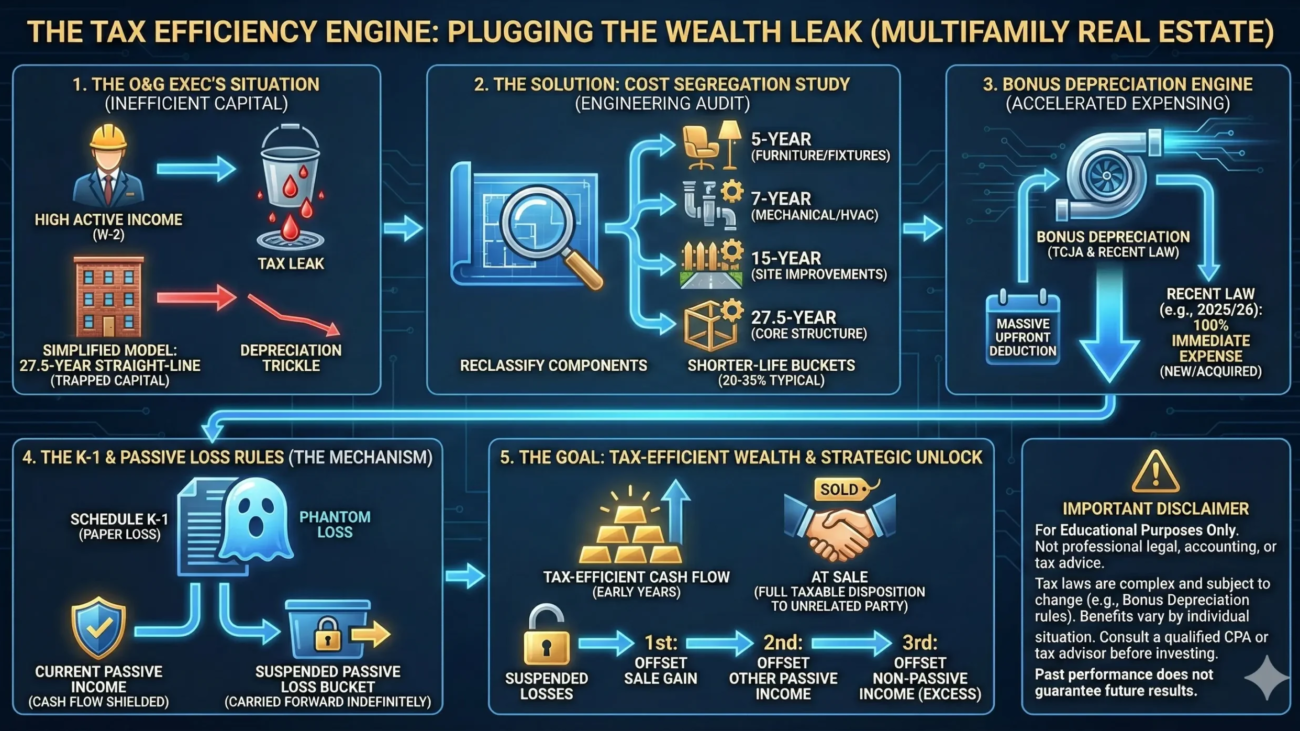
The “Phantom Loss” Strategy for High Earners

For high-net-worth executives in the Oil & Gas sector, tax mitigation is not merely a convenience; it is a critical component of wealth preservation. You are likely already familiar with sector-specific mechanisms such as Intangible Drilling Costs (IDCs) and the percentage depletion allowance. These Congress-enacted tools are essential for de-risking significant capital expenditures in exploration and production.

Institutional-grade multifamily real estate offers a parallel—and arguably more powerful—tax mechanism utilized by sophisticated family offices and wealth managers: Cost Segregation combined with Bonus Depreciation.

While tax rules allow for shorter recovery periods for specific property components, many smaller or passive investors effectively treat an entire residential property as a single 27.5-year “building” asset for simplicity. This often leads to an inefficient use of capital, as tax-saving potential is trapped within the structure for nearly three decades. Best practice in institutional asset management involves treating the property not as a single block, but as an assembly of distinct industrial components, each with its own specific useful life as defined by the IRS.

What is a Cost Segregation Study?

A Cost Segregation Study is a technical, forensic engineering-based audit of a commercial property. While there is no explicit statutory requirement that only engineers perform these studies, IRS guidance identifies detailed engineering-based studies as best practice for establishing the legal and physical basis for accelerated depreciation.

The objective is to reclassify assets that would normally be effectively claimed over 27.5 years (residential) or 39 years (commercial) into shorter recovery periods—specifically 5, 7, and 15-year asset classes. The legal basis for these studies rests on seminal tax court cases (such as Hospital Corporation of America v. Commissioner) and specific IRS revenue procedures. By properly identifying and documenting these components, a significant portion of the building’s purchase price—often in the range of 20%–35% depending on the property type—can be shifted into shorter-life classes.

The engineering team assigns values to components such as:

  • 5-Year Property: Carpeting, specialized lighting, dedicated electrical outlets for equipment, cabinetry, and removable fixtures.
  • 7-Year Property: Certain telecommunications equipment and office furniture.
  • 15-Year Property: Land improvements like sidewalks, paving, curbing, fences, landscaping, and storm sewers.

The Engine of Efficiency: Bonus Depreciation and Recent Law Changes

Identifying these shorter-life assets is only the first step. The true power of this strategy lies in Bonus Depreciation, which allows investors to immediately expense a large percentage of an asset’s cost in the year it is placed in service. Under the Tax Cuts and Jobs Act (TCJA), this benefit applies to both new construction and acquired (used) properties, provided the property is “new to the taxpayer” and meets the specific acquisition requirements under IRC 168(k).

As of early 2026, it is critical for investors to recognize that the bonus depreciation landscape has evolved beyond the original TCJA phase-out schedule. While the original law saw percentages drop from 100% in 2022 down to 40% in 2025, subsequent legislation (often referred to as the “One Big Beautiful Bill”) has restored 100% bonus depreciation for qualifying property placed in service after January 19, 2025. Property placed in service earlier in 2025 may be subject to different treatment.

Because tax law is currently nuanced and subject to recent legislative adjustments, investors must confirm the exact applicable percentages for their specific acquisition date with a qualified CPA.

Comparison: Simplified vs. Component-Based Depreciation

The following table illustrates how identifying specific components unlocks faster recovery.

Component Type Simplified/Small Investor Model Component-Based (Cost Segregation) Model
Core Structure (Walls, Roof, Foundation) 27.5 Years (Straight Line) 27.5 Years (Straight Line)
Mechanical/HVAC Components Effectively 27.5 Years 5 – 7 Years (Eligible for Bonus)
Site Improvements (Parking, Landscaping) Effectively 27.5 Years 15 Years (Eligible for Bonus)
Furniture/Fixtures/Specialty Electric Effectively 27.5 Years 5 Years (Eligible for Bonus)

The Engineering of a K-1: Navigating Passive Loss Rules

The practical outcome of this strategy is experienced when the investor receives their IRS Schedule K-1. While an asset may be producing real monthly cash flow, the K-1 may show a substantial net loss for tax purposes due to the heavy depreciation expense taken. For many investors, these deductions can significantly reduce or even eliminate taxable income from the investment in early years, depending on their broader passive income picture and current law.

The Passive Bucket and “Suspended Losses”

The IRS generally categorizes income into three buckets: Active/Earned (W-2), Portfolio (Stocks/Dividends), and Passive (Rental Real Estate). For high-income executives, passive losses typically cannot offset W-2 salary or stock dividends in the current year. While a limited “active participation” exception exists that allows for a modest rental loss offset, this phases out at higher income levels and typically does not benefit the high-income O&G professional.

However, if these losses exceed your passive income, they become Suspended Passive Losses, which are carried forward indefinitely.

The Strategic Unlock at Sale

Upon the fully taxable disposition of an investor’s entire interest in a passive activity to an unrelated party (under IRC 469(g)), any remaining suspended losses associated with that specific activity are “unlocked.” Following IRS ordering rules, these losses are first applied against the gain from the sale of that activity, then against other passive income. If losses remain after these steps, the excess may then be treated as non-passive and used to offset other types of income.

The Goal: Achieving Tax-Efficient Cash Flow

The strategic objective is to engineer a scenario where investors receive positive cash-on-cash returns that are shielded from federal income taxes during the initial years of ownership. This isn’t a “loophole”—it is the disciplined application of the tax code to encourage infrastructure investment.

IMPORTANT DISCLAIMERS

The information provided in this article is for educational and informational purposes only and should not be construed as professional legal, accounting, or tax advice. Neither Anchorstone Investments nor its principals are licensed CPA firms or tax attorneys. Tax laws, particularly those regarding Bonus Depreciation and the “One Big Beautiful Bill,” are highly complex, nuanced, and subject to ongoing legislative changes, IRS interpretations, and court rulings.

Individual tax situations vary significantly. The benefits of these strategies depend on numerous factors, including an investor’s adjusted gross income, other sources of passive income, and specific acquisition dates. Investors MUST consult with their own qualified CPAs or tax advisors to confirm current law and determine how these strategies apply to their specific financial situation before making any investment decisions.


image_1015x498

The Engineering Of Wealth Preservation

Executive Summary: Bridging the Gap Between Industry and Asset

In the global energy sector, we do not operate on “intuition” or “market sentiment.” We rely on high-fidelity geological surveys, automated control systems, and the rigorous management of multi-million dollar P&L statements to ensure a return on capital. When a project is offshore or subsea, the margin for error is zero. We architect systems that account for every variable, from pressure spikes to supply chain bottlenecks.

Anchorstone Investments was founded on a simple question: Why should your private wealth be managed with any less precision than a subsea tie-back?

We believe that real estate is not a “passive” hobby or a side-hustle. It is an industrial operation. We apply the same level of engineering precision, data analytics, and operational discipline used in the world’s most complex industrial environments to the 100+ unit multifamily housing market. At Anchorstone, we don’t just “buy buildings”; we acquire under-optimized residential assets and install an institutional-grade Operating System designed to maximize Net Operating Income ($NOI$) and protect investor equity.

The Concentrated Risk Problem: The Invisible “Single-Point Failure”

Most Oil & Gas professionals—directors, VPs, and senior engineers—are inadvertently over-leveraged in a single sector. Your primary income, your annual performance bonuses, and your 401(k) are often tied directly or indirectly to the same commodity cycles. When the price of Brent or WTI drops, your entire financial ecosystem feels the shockwave. This is what we call a “Single-Point Failure” in engineering terms.

Furthermore, traditional “diversification” into the stock market often fails to provide true stability. Paper assets are liquid but highly emotional; they are subject to the whims of the ticker and the volatility of global headlines. You are left as a passive observer with zero control over the underlying management, the efficiency of the operations, or the tax inefficiencies of high-turnover portfolios.

For the high-earning executive, the greatest “leak” in the wealth system isn’t market volatility—it is Taxation and Inflation. A standard stock portfolio does little to shield you from either.

The Anchorstone Solution: Systematic Grounding

Anchorstone provides what we call “Systematic Grounding.” We focus exclusively on institutional-scale multifamily syndications (typically 100 to 250 units). We choose this asset class because it mirrors the stability of a managed industrial field. At this scale, the property is a self-sustaining business unit, capable of supporting full-time professional management and sophisticated automation.

Our investment thesis provides three distinct layers of protection for your legacy:

  1. Capital Preservation: We target assets with high intrinsic value located in “Inflection Point” markets—areas where job growth, infrastructure development, and population migration are backed by hard data, not speculation.
  2. Tax Shielding: Through the use of cost segregation and accelerated depreciation, we create “paper losses” that can offset your passive income. Our goal is to ensure you keep more of every dollar generated by the asset.
  3. Operational Optimization: We treat every apartment complex as a standalone business unit. We optimize NOI—the fundamental driver of asset value—through the same P&L discipline I used to manage $35M+ global software and automation divisions.

Comparative Analysis: Wealth Strategies

Performance Metric Traditional 401(k) / S&P 500 Anchorstone MFH Syndication
Control Over Management Zero High (Active Asset Management)
Volatility Profile High (Market/Ticker Driven) Low (Asset-Backed / Value-Driven)
Tax Efficiency Low (Subject to Capital Gains) Superior (Depreciation/K-1 Benefits)
Inflation Protection Indirect Direct (Rent adjusts with CPI)
Leverage Potential Limited High (Bank-Financed Institutional Debt)
Principal Skillset Financial Advisor (Sales) Executive Operator (P&L/Systems)

The Anchorstone “Operating System” (OS)

In industrial automation, the Operating System is what ensures the plant runs at 99.9% uptime. At Anchorstone, we have developed a proprietary management framework we call the Anchorstone OS. We don’t just hope for a property manager to do a good job; we install a protocol for success.

  • Predictive Leasing Cycles: We utilize AI-driven lead management to identify vacancy trends before they occur. By reducing the “Lease-Up” lag time, we increase the effective gross income of the property without increasing rent.
  • Supply Chain Discipline: We leverage institutional vendor networks to consolidate maintenance and CapEx costs. By applying “Zero-Based Budgeting,” we often reduce operating expenses by 15-20% compared to previous “mom-and-pop” ownership.
  • Data-Driven Tenant Retention: Using the same predictive analytics concepts found in Snowflake or Azure Data Lakes, we track tenant behavior patterns. We identify “at-risk” renewals early and intervene with incentives that cost significantly less than a full unit turnover.

Why Scale Matters: The Math of the 100-Unit Engine

In engineering, we know that certain systems only become efficient at scale. A single wellhead is a gamble; a field development is a strategy. Real estate follows the same physics.

A 4-unit “four-plex” is a fragile system. If one tenant vacates, you are 25% vacant and likely “out of pocket” for the mortgage. Furthermore, a 4-unit building cannot support on-site staff, meaning the “systems” are usually just the owner with a smartphone.

A 150-unit complex is a robust engine. If five tenants leave, you are still 96.6% occupied. The property generates enough revenue to support a professional on-site manager, a full-time maintenance tech, and 24/7 security. This scale allows us to implement Institutional-Grade Asset Management, turning a building into a predictable cash-flow machine.

Conclusion: Engineering Your Exit

You have spent your career managing complex systems and driving profitability for others. It is time to apply those same professional standards to your own balance sheet. Anchorstone Investments is not looking for “customers”; we are looking for sophisticated partners who value data, discipline, and the “Stable Grounding” of hard assets.

Stop watching the ticker. Start watching the engine.

A high-contrast, photorealistic wide shot of a massive, modern 200-unit apartment complex during the “blue hour” (dusk). The building features clean lines, glass, and steel. Superimposed over the image is a translucent, glowing 3D CAD architectural wireframe or “Digital Twin” overlay, showing structural stress points and data nodes. The aesthetic is “High-Tech Engineering meets Luxury Real Estate.” Colors: Deep navy, slate grey, and warm amber light glowing from the unit windows. 8k resolution, cinematic lighting. Keywords: Structural integrity, Foundation, Blueprint, Optimization.


2149718460

Why Northwest Houston Multifamily is the Best Hedge Against Inflation

A Strategic Outlook for Accredited Investors (2025-2026)

Author: AnchorStone Investments

Executive Summary

In an economic environment defined by stubborn inflation and volatile stock markets, accredited investors are increasingly pivoting to hard assets. This report analyzes why Class B Multifamily Real Estate in Northwest Houston (Cypress, Tomball, Katy) offers a superior risk-adjusted hedge against currency devaluation compared to gold, S&P 500, or single-family rentals.

  1. The Inflation-Hedge Mechanism

Real estate is often cited as an inflation hedge, but not all real estate is equal. Multifamily assets in high-growth corridors perform best due to the “Annual Reset” advantage.

  • The Mechanism: Unlike commercial leases locked for 5-10 years, apartment leases reset every 12 months.
  • The Data: Historically, multifamily rents have outpaced inflation by 1.27% annually since 1980. In hyper-inflationary periods (like 2021-2022), rents in high-demand zones rose 13-17%, far exceeding the CPI.
  • The AnchorStone Strategy: We target assets where rents are artificially low. By renovating units, we force appreciation that exceeds the inflation rate, protecting your purchasing power.
  1. Why Northwest Houston? (The “Golden Corridor”)

While the national market cools, Northwest Houston is experiencing a “flight to affordability” and job growth.

  • Population Boom: Harris County added over 105,000 residents in the last year alone, with the bulk of suburban migration moving Northwest toward Cypress and Tomball.
  • Job Anchors: Major employers like Hewlett Packard Enterprise (HPE), ExxonMobil Campus, and the expanding Houston Methodist Willowbrook provide a recession-resistant tenant base.
  • Limited Supply: High construction costs and interest rates have stalled new developments by ~64% in 2024. This “supply cliff” means existing Class B apartments will face zero competition from new builds in 2026, driving occupancy and rents upward.
  1. The “Class B” Advantage

Why not luxury (Class A) or low-end (Class C)?

  • Class A (Luxury): Too sensitive to recessions. When the economy tightens, tenants downgrade.
  • Class C (Distressed): High delinquency risk.
  • Class B (Workforce Housing): The “Safety Valve.” In good times, Class C tenants move up to B. In bad times, Class A tenants move down to B. Northwest Houston Class B assets currently show stabilized occupancy near 93-95%, significantly outperforming the national average.
  1. AnchorStone’s 2025 Forecast

  • Rent Growth: Projected 2.1% – 3.5% organic growth in NW Houston (vs. 2% national average).
  • Appreciation: Forced appreciation through strategic value-add renovation allows us to target 15-20% IRR (Internal Rate of Return) over a 5-year hold.
  • Tax Benefits: Investors benefit from Bonus Depreciation, allowing for significant paper losses to offset passive income—a tax efficiency stocks cannot offer.